Data Request Cabinet
v0.1.0Structured intake, triage, and delivery for every business data question — from the Slack "can someone pull this?" to a routed, answered, and filed data request packet. Keep Jira and Slack; replace the untracked data asks that block your team.
Data Request Cabinet
agents
Data Analyst
.agents/analyst/
Routing Agent
.agents/routing-agent/
Daily Request Triage
0 9 * * 1-5
Weekly Data Team Throughput Report
0 8 * * 1
2
Agents
2
Jobs
1
Depts
4
Pages
Executes routed data requests — writes SQL, produces the answer packet (data + narrative + caveats), and files it back to the queue for delivery to the requester.
Classifies, prioritizes, and routes every incoming data request — deflects common questions, assigns SLAs, and tracks the queue from intake to delivery.
Data Request Cabinet
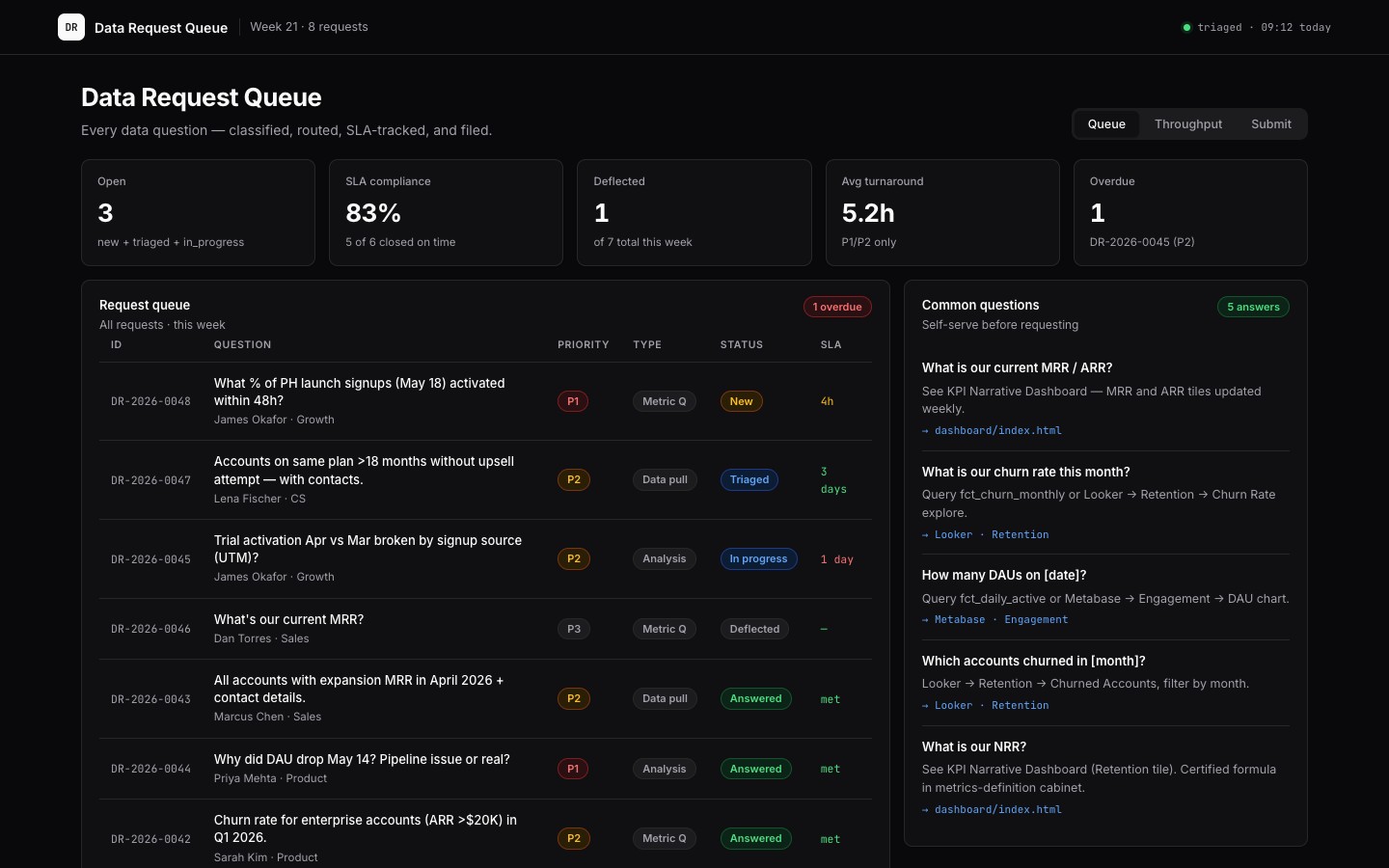
Business questions flow in from Slack, email, and Jira and disappear without an answer. This cabinet structures every data request from intake to delivery: a Routing Agent classifies the question, checks whether it's already answered in the common-questions library, assigns it to an analyst with a priority and SLA, and the Analyst delivers a structured answer packet. Every request is a file — trackable, auditable, and reusable.
Keep Slack, Jira, and your BI tools. Replace the invisible queue of data asks, the duplicate requests nobody cross-references, and the "I think someone answered this before" archaeology.
The team
- [[.agents/routing-agent]] — Routing Agent. Lead orchestrator. Classifies incoming requests, deflects common questions, assigns priority and SLA, routes to the Analyst, and tracks through to delivery. Owns the queue health.
- [[.agents/analyst]] — Data Analyst. Executes assigned requests: writes SQL against the warehouse, produces the answer packet (data + narrative + caveats), and files it back. Owns delivery quality.
Recurring rhythm
| Cadence | Job | Owner | Output |
|---|---|---|---|
| Daily (Mon–Fri 09:00) | [[.jobs/daily-request-triage]] | Routing Agent | New requests classified, routed, and updated in [[queue/requests.yaml]] |
| Weekly (Mon 08:00) | [[.jobs/weekly-throughput-report]] | Routing Agent | Throughput report in [[queue/throughput/]] with SLA compliance, backlog age, and team load |
How to run the demo
- Open the [[queue]] — the data request queue: question, requester, priority, assigned analyst, status, and SLA countdown. Submit new requests via the intake form.
- Browse [[queue/requests.yaml]] — the YAML file that is the queue's source of truth.
- Browse [[queue/answers/]] — filed answer packets from completed requests.
- Check [[queue/common-questions.md]] — the deflection library built from recurring request patterns.
Connectors
Required: Snowflake or BigQuery (warehouse for SQL execution); Slack (request intake and answer delivery). Recommended: Jira (ticket creation + sync for engineering-adjacent requests); Looker or Metabase (self-serve deflection links); Google Sheets (for requesters who prefer a spreadsheet answer).
Every request is a file. The intake, the routing decision, the answer, and the caveats all live in queue/ — searchable, diffable, and usable as future deflection material.
$ git clone --filter=blob:none --sparse https://github.com/hilash/cabinets.git && cd cabinets && git sparse-checkout set data-request