
Incident Postmortem Cabinet
v0.1.0Builds complete incident timelines, root-cause analyses, and action-item registers from PagerDuty, Datadog, Sentry, and Slack — published within hours of resolution. Keep your alerting stack. Replace the blank Confluence page and the week-late postmortem.
Incident Postmortem Cabinet
agents
Engineering Agent
.agents/engineering-agent/
Per-Incident Postmortem
QA Agent
.agents/qa-agent/
Weekly Action-Item Follow-up
0 9 * * 1
Summary Agent
.agents/summary-agent/
3
Agents
2
Jobs
1
Depts
2
Pages
Builds the incident timeline from PagerDuty, Datadog, Sentry, and Slack — the factual backbone of every postmortem — and orchestrates the Summary and QA Agents to complete the report.
Reviews the draft postmortem for completeness — every action item has an owner, a due date, and a Jira ticket — before the report is published and tracks action-item status weekly.
Writes the root-cause analysis, 5-whys breakdown, customer-impact statement, and contributing-factors section from the Engineering Agent's incident timeline.
Incident Postmortem Cabinet
Three agents turn a resolved incident into a complete, blameless postmortem within hours: the Engineering Agent builds the timeline from PagerDuty, Datadog, and Sentry; the Summary Agent writes the root-cause analysis and customer-impact statement; the QA Agent validates the action items for completeness and owner assignment before the report is published.
Keep PagerDuty, Datadog, and Sentry. Replace the blank Confluence page, the week-late postmortem, and the action items that fall into a Jira backlog nobody watches.
The team
- [[.agents/engineering-agent]] — Engineering Agent. Owns timeline construction: pulls alert events, deployment markers, error spikes, and Slack incident channel messages to build a minute-by-minute timeline. Orchestrates the other agents.
- [[.agents/summary-agent]] — Summary Agent. Writes the root-cause narrative, 5-whys analysis, customer-impact quantification, and contributing-factors section from the timeline.
- [[.agents/qa-agent]] — QA Agent. Reviews the full draft postmortem: checks every action item has an owner, a due date, and a Jira ticket; flags gaps before the report is published.
Recurring rhythm
| Cadence | Job | Owner | Output |
|---|---|---|---|
| On-demand (per incident) | [[.jobs/per-incident-postmortem]] | Engineering Agent (all three) | Postmortem in [[report]] + postmortems/<incident-id>.md |
| Weekly (Mon 09:00) | [[.jobs/weekly-action-item-followup]] | QA Agent | Action-item status in postmortems/action-items.md |
How to run the demo
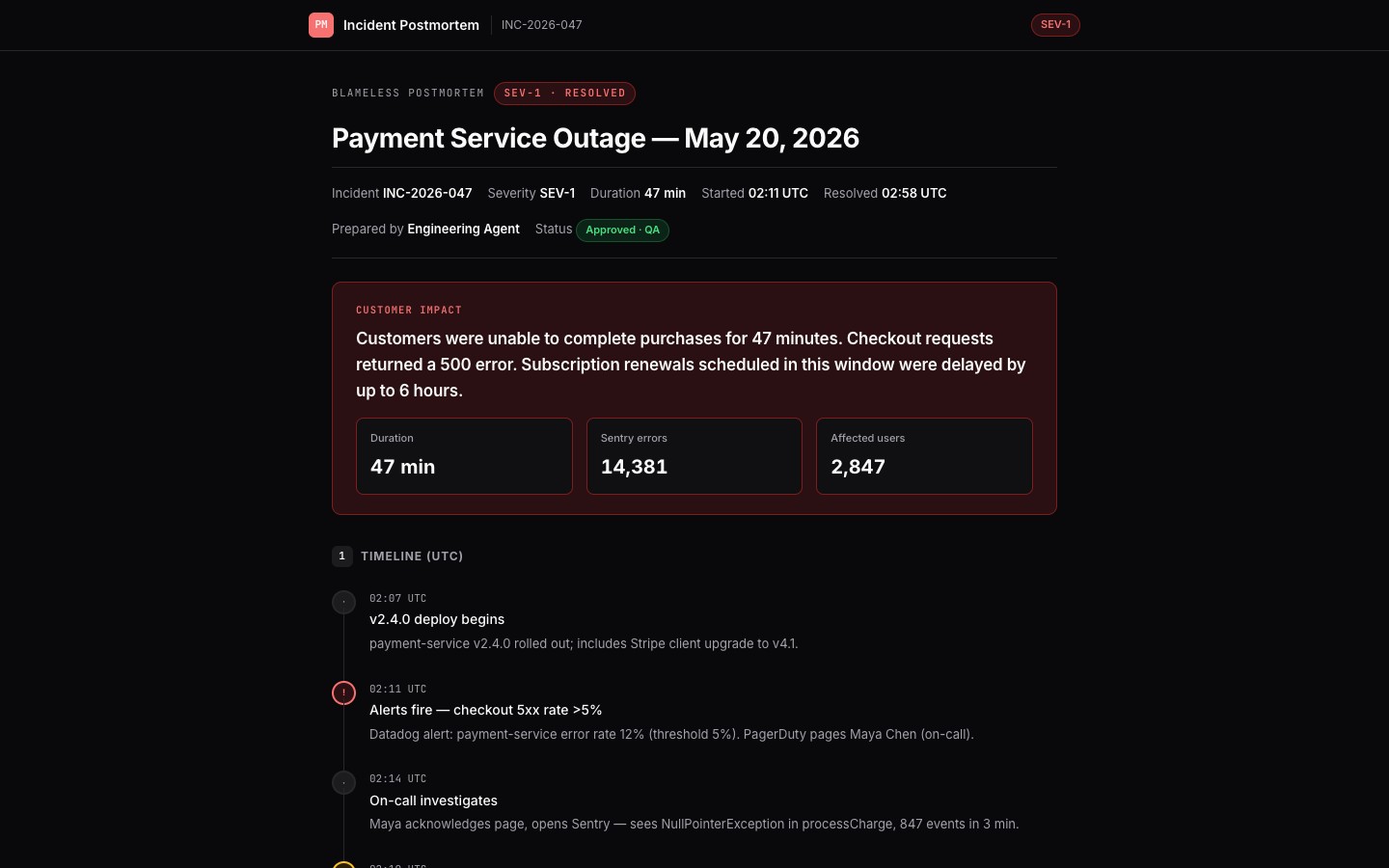
- Open the [[report]] — the postmortem report for INC-2024-047: incident header with severity and duration, customer impact, timeline, root cause with 5-whys, contributing factors, and action items with owners.
- Open
postmortems/action-items.md— the running action-item register across all recent incidents.
Connectors
Required: PagerDuty or Opsgenie (alert timeline), Datadog or Grafana (metrics + deployment markers), Sentry (error traces). Recommended: Slack (incident channel export), Jira (action-item tickets), Statuspage (customer-impact wording).
Every artifact is a file — the postmortem lives in postmortems/ dated by incident ID, blameless, diffable, and searchable.
$ git clone --filter=blob:none --sparse https://github.com/hilash/cabinets.git && cd cabinets && git sparse-checkout set incident-postmortem