Physics Experiments
v0.1.0Five interactive, self-contained simulations of classic physics experiments — double-slit, pendulum wave, projectile motion, wave interference, and the brachistochrone race. Vanilla JS + Canvas 2D, zero build step, runs entirely in the browser. Each experiment is a full-screen Cabinet app you can open from the sidebar.
Physics Experiments
agents
Curator
.agents/curator/
Weekly Experiment Spotlight
0 10 * * 1
1
Agents
1
Jobs
1
Depts
1
Pages
Curates the experiment collection, explains the physics behind each demo, and proposes new classic experiments to add
Physics Experiments
Interactive, self-contained simulations of classic physics experiments. Each folder is an embedded web app — open it from the sidebar to launch full-screen.
Mechanics — how things move
- Galileo's Inclined Plane (
inclined-plane/) — The 1604 experiment that broke Aristotle. Roll a ball down a tilted ramp, time the segments, watch distance grow as t² — proving constant acceleration before clocks could measure it directly. - Brachistochrone (
brachistochrone/) — Race three balls down straight, circular, and cycloid paths. The cycloid wins — every time. Bernoulli's 1696 puzzle. - Projectile Motion (
projectile-motion/) — Classical ballistics. Tune angle, velocity, and gravity; trace the parabola. - Foucault Pendulum (
foucault-pendulum/) — Paris, 1851. A 28 kg pendulum swings in the Panthéon and its plane appears to rotate — but it's the Earth turning underneath. Adjust latitude and watch the rotation period change. - Pendulum Wave (
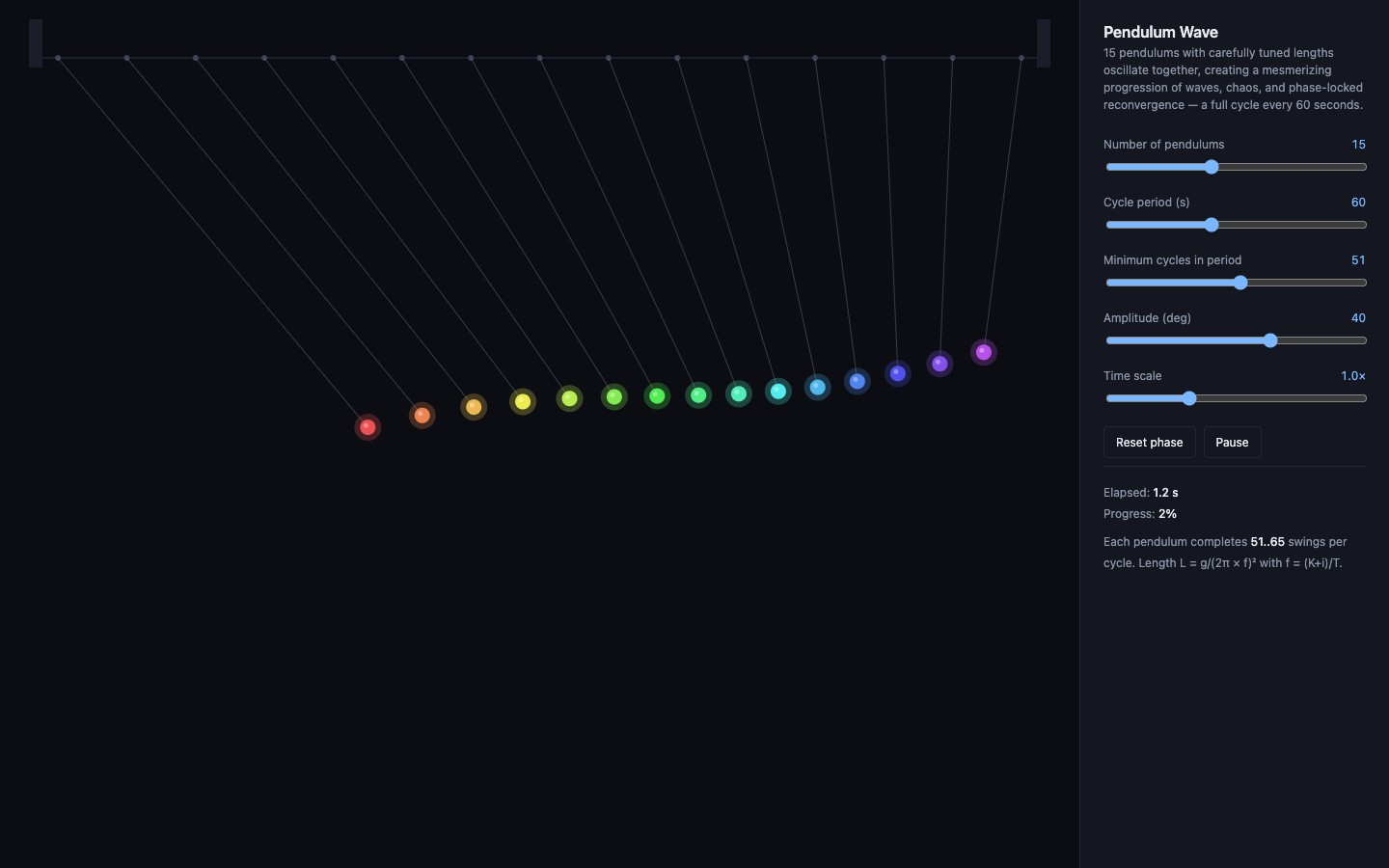
pendulum-wave/) — 15 pendulums tuned to subtly different periods. Pull them in unison, watch chaos resolve into a standing wave, then back into chaos. Pure math, made visible.
Waves & light
- Double-Slit (
double-slit/) — Wave-particle duality. Fire one photon at a time and watch an interference pattern emerge from individual hits. The experiment Feynman called "the only mystery." - Wave Interference (
wave-interference/) — Two coherent point sources on a ripple tank. Adjust separation and wavelength to reshape the pattern.
Quantum
- Stern-Gerlach Lab (
stern-gerlach/) — Frankfurt, 1922. Send silver atoms through a non-uniform magnetic field. Classical physics predicts a smear; the screen shows two discrete spots. Spin is quantized. Now stack analyzers to discover the non-commutativity that built quantum mechanics. - Quantum Tunneling (
quantum-tunneling/) — A live Schrödinger solver. Launch a Gaussian wave packet at a potential barrier taller than its own energy — classically forbidden — and watch part of it leak straight through. Tune energy, barrier height, and thickness; the measured transmission tracks the textbook tunneling formula in real time. - Millikan Oil Drop (
millikan-oil-drop/) — Chicago, 1909. Suspend tiny charged oil droplets between charged plates, balance gravity against electric force, measure the charge. Find that every drop is an integer multiple of one number: e ≈ 1.602×10⁻¹⁹ C. Charge is quantized too.
Solid state
- Bragg X-ray Diffraction (
bragg-diffraction/) — Cambridge, 1913 (Nobel 1915). Aim X-rays at a crystal, sweep the angle θ, watch peaks erupt only where 2d sin θ = nλ. The experiment that proved crystals are periodic lattices and gave us every structural-biology and materials-science result since. Toggle simple-cubic / BCC / FCC and see how the structure factor kills certain peaks.
Implementation notes
Each experiment is a directory with an index.html file plus a .app marker so Cabinet renders it full-screen. Built with vanilla JS + Canvas 2D — zero build step, zero external libs. Open any HTML file directly in a browser if you want to hack on it.
Why these eleven
They cover the five moments physics changed:
- Mechanics is mathematical (Galileo, Bernoulli, Newton via projectile motion)
- The Earth moves (Foucault — physics confirms cosmology by direct demo)
- Light is weirder than waves OR particles (double-slit, wave interference)
- Reality is quantized (Stern-Gerlach for spin, Millikan for charge)
- Matter obeys a wave equation (quantum tunneling — barriers leak, and once you know that, the scanning tunneling microscope and flash memory follow)
- Matter is periodic (Bragg — and once you know that, every transistor follows)
Read the cabinet top-to-bottom and you've toured 350 years of physics in the order it actually happened.
$ git clone --filter=blob:none --sparse https://github.com/hilash/cabinets.git && cd cabinets && git sparse-checkout set physics-experiments