
PRD Builder
v0.1.0Generates structured PRD drafts from customer pain, business goals, user stories, and constraints — then runs a completeness QA pass to ensure every section is production-ready before handoff to engineering. Keep your Jira; replace the half-empty Google Doc that engineers pad with assumptions.
PRD Builder
agents
PRD QA
.agents/prd-qa/
Weekly PRD Completeness QA
0 8 * * 1
Product Manager
.agents/product-manager/
Generate PRD
Weekly Competitor Watch
0 8 * * 1
Product Writer
.agents/product-writer/
3
Agents
3
Jobs
1
Depts
2
Pages
Runs a section-by-section completeness and quality check on every PRD before engineering handoff — flagging missing acceptance criteria, vague requirements, undefined metrics, and open questions past their due date.
Owns PRD initiation and final sign-off. Defines the problem statement, goal, user segments, and success metrics; orchestrates the Writer and QA agents; and ensures each PRD is engineering-ready before handoff.
Drafts the full PRD structure from the PM's brief — problem, users, user stories, functional and non-functional requirements, risks, and open questions — with engineering-grade specificity.
PRD Builder
Three agents collaborate to produce a complete, engineering-ready PRD from a brief: the Product Manager extracts problem and goal, the Writer drafts the structured document, and the QA agent runs a completeness check before handoff. Every PRD section — problem, users, user stories, requirements, success metrics, risks, open questions — is a file, diffable, and linkable from Jira.
Keep your Jira and your Figma. Replace the half-empty Google Doc that lives in 12 copies, the PRD template nobody fills in properly, and the "can you clarify the requirements?" back-and-forth that delays engineering by two sprints.
The team
- [[.agents/product-manager]] — Product Manager. Defines problem, goal, user segments, and success metrics. Runs the PRD initiation session and owns the final document.
- [[.agents/product-writer]] — Product Writer. Drafts the full PRD structure from the PM's brief: problem statement, users, user stories, functional requirements, non-functional requirements, risks, and open questions.
- [[.agents/prd-qa]] — PRD QA. Runs a section-by-section completeness check: missing acceptance criteria, vague requirements, undefined success metrics, unresolved risks, and open questions older than 48h.
Recurring rhythm
| Cadence | Job | Owner | Output |
|---|---|---|---|
| On-demand | [[.jobs/generate-prd]] | Product Manager → Writer → QA | New PRD in [[prd]], source in /prds/ |
| Weekly (Mon 08:00) | [[.jobs/weekly-prd-qa]] | PRD QA | Completeness audit of all open PRDs in /prds/ |
| Weekly (Mon 08:00) | [[.jobs/weekly-competitor-watch]] | Product Manager | Competitor feature precedents for open PRDs |
How to run the demo
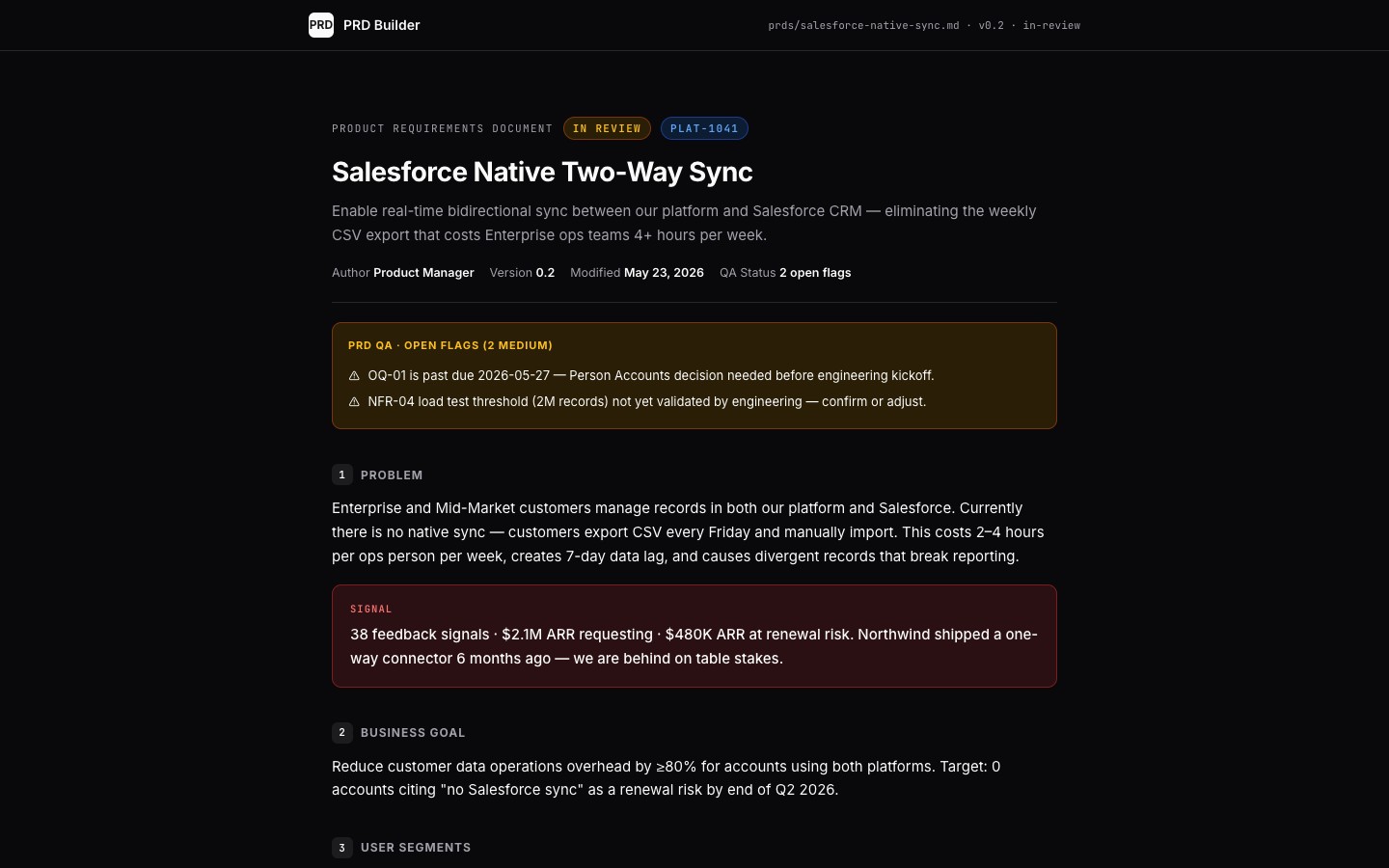
- Open [[prd]] — the PRD document view: problem, goal, users, user stories, requirements table, success metrics, risks, and open questions — formatted as a structured report.
- Browse
/prds/— the source markdown PRDs the agents generate and maintain. - Open
/qa-reports/— the weekly completeness audit reports.
Connectors
Required: Jira or Linear (link PRDs to epics), customer feedback (VoC + Feature Request cabinets). Recommended: Figma (design links embedded in requirements), Slack (share PRD for async review), Confluence (export for wider team).
Cross-reference [[competitive-intelligence]] for competitor feature precedents when writing requirements.
Every artifact is a file
Every PRD is a standalone markdown file in /prds/<feature-slug>.md. The webapp renders the latest PRD from that file. QA reports are in /qa-reports/. Nothing is locked in a UI.
$ git clone --filter=blob:none --sparse https://github.com/hilash/cabinets.git && cd cabinets && git sparse-checkout set prd-builder