
Support Macro Cabinet
v0.1.0Generates, QA-reviews, and maintains a library of reusable support macros from real ticket clusters — so every rep pulls a reviewed, on-brand reply instead of writing from scratch. Keep Zendesk macros or Intercom snippets. Replace the outdated canned responses, the Google Doc nobody updates, and the tone drift nobody catches.
Support Macro Cabinet
agents
Macro QA Reviewer
.agents/macro-qa/
Weekly Macro Freshness QA
0 16 * * 5
Macro Writer
.agents/macro-writer/
Weekly Macro Coverage Review
0 8 * * 1
2
Agents
2
Jobs
1
Depts
17
Pages
Audits active and draft macros for accuracy, tone, broken links, and outdated product references — returning flagged macros to the Macro Writer for revision before they reach a customer.
Drafts new support macros from ticket cluster data, updates the macro registry, and sequences the weekly coverage review — ensuring every high-volume ticket pattern has a reviewed, on-brand canned response.
Support Macro Cabinet
Two agents generate reusable support macros from live ticket clusters, QA each macro for tone, accuracy, and link freshness, and publish a maintained macro library — so every support rep pulls a reviewed, on-brand reply instead of writing from scratch or copying a three-year-old snippet. Every macro, every QA pass, and every usage report is a file your support ops team can inspect and approve.
Keep Zendesk macros or Intercom snippets. Replace the outdated canned responses, the Google Doc nobody updates, and the tone drift nobody catches until a customer complains.
Why this template
Macro libraries drift. Responses that were accurate at launch reference deprecated features, old pricing, or dead links within months. Meanwhile, high-volume new ticket patterns — API errors, billing confusion, mobile bugs — don't get macros at all, so reps improvise. This cabinet makes macro maintenance a scheduled operation: new macros are drafted from real clusters, existing ones are QA'd for freshness weekly, and usage data tells you which macros to invest in.
The team
- [[.agents/macro-writer]] — Macro Writer. Lead agent. Drafts new macros from ticket cluster data using customer-tested language, updates the macro registry, and sequences the weekly coverage review. Owns the macro library.
- [[.agents/macro-qa]] — Macro QA Reviewer. Audits existing macros for accuracy, tone, broken links, and outdated product references. Does not write macros — flags and returns them to the Writer for revision.
Recurring rhythm
| Cadence | Job | Owner | Output |
|---|---|---|---|
| Weekly (Mon 08:00) | [[.jobs/weekly-macro-coverage-review]] | Macro Writer | New macro drafts for uncovered clusters; usage report |
| Weekly (Fri 16:00) | [[.jobs/weekly-macro-freshness-qa]] | Macro QA Reviewer | QA report + macros flagged for revision or retirement |
How to run the demo
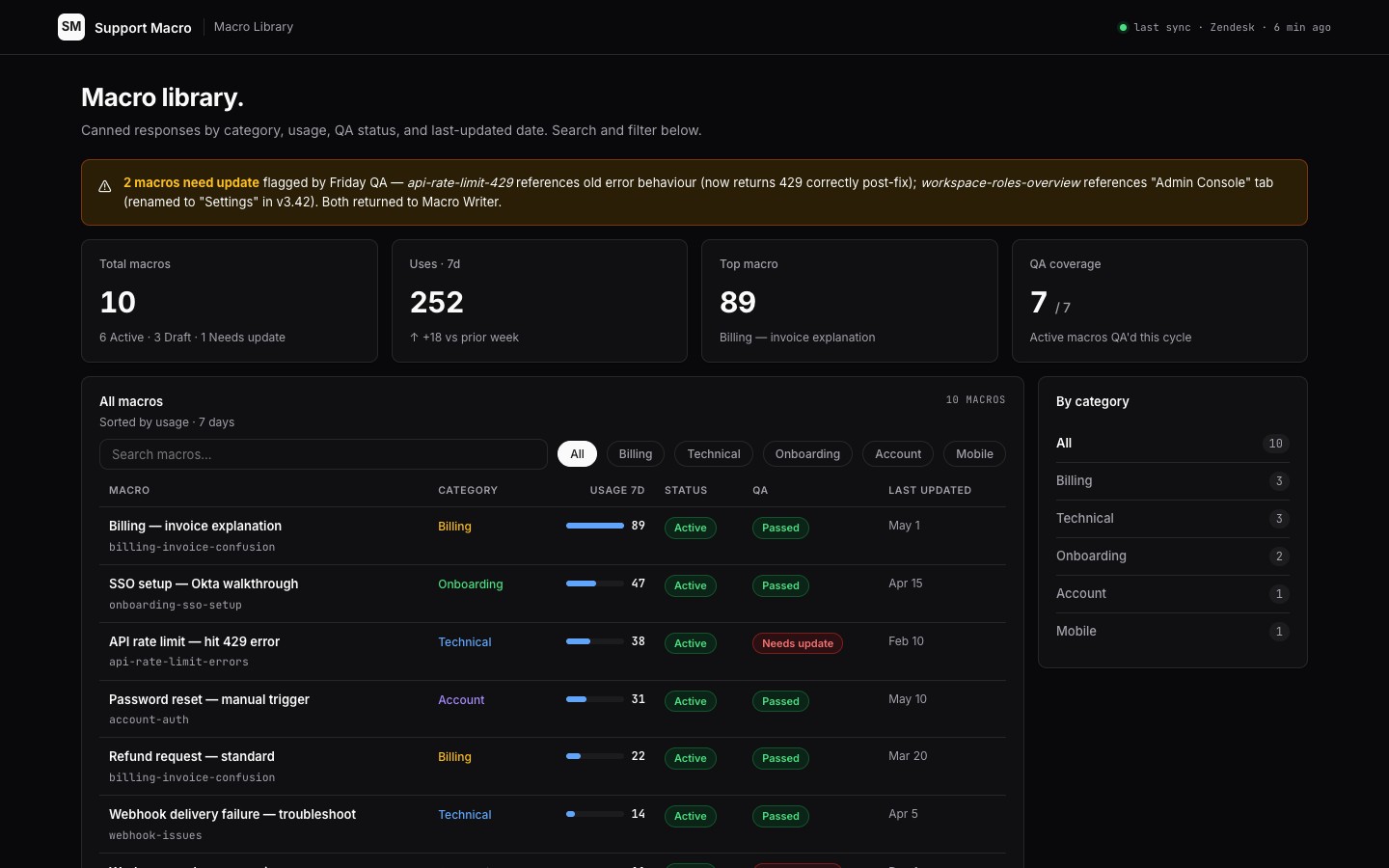
- Open the [[macro-library]] — categorised canned responses with usage frequency, last-updated date, linked ticket cluster, and tone/QA status. Includes search and filter.
- Browse
/macros/— each macro as an individual markdown file with metadata, body text, and QA history. - Open
/macro-registry.md— the canonical registry: all macros, status, cluster linkage, and last QA date.
Connectors
Required: Zendesk or Intercom (ticket source for cluster data; macro publish destination).
Recommended: Knowledge base / Help Center (link macros to full articles), Slack (#support-macros for weekly QA summaries).
Macro library snapshot (demo data)
| Macro | Category | Usage (7d) | QA Status | Last Updated |
|---|---|---|---|---|
| Billing — invoice explanation | Billing | 89 | Passed | 2026-05-01 |
| SSO setup — Okta walkthrough | Onboarding | 47 | Passed | 2026-04-15 |
| API rate limit — hit 429 error | Technical | 38 | Needs update | 2026-02-10 |
| Password reset — manual trigger | Account | 31 | Passed | 2026-05-10 |
| CSV export — row limit workaround | Technical | 24 | Draft | — |
| Refund request — standard | Billing | 22 | Passed | 2026-03-20 |
| iOS login loop — known issue | Mobile | 18 | Draft | — |
Every macro in /macros/ carries a QA stamp, a cluster link, and a reason it was written.
$ git clone --filter=blob:none --sparse https://github.com/hilash/cabinets.git && cd cabinets && git sparse-checkout set support-macro