
Voice of Customer
v0.1.0Collects, clusters, and quantifies customer feedback across every channel — support, sales calls, reviews, and chat — turning raw signals into ranked themes with revenue impact. Keep your CRM and Zendesk; replace the feedback spreadsheet nobody trusts.
Voice of Customer
agents
Customer Insights
.agents/customer-insights/
Daily Feedback Intake
0 9 * * 1-5
VoC Lead
.agents/product-lead/
Weekly Competitor Watch
0 8 * * 1
Weekly Theme Clustering
0 8 * * 1
VoC Analyst
.agents/voc-analyst/
3
Agents
3
Jobs
1
Depts
2
Pages
Reads raw feedback from every channel daily, tags each item by source, type, segment, and sentiment, and maintains the verbatim log at /feedback/log.md.
Owns the weekly VoC digest and revenue-impact scoring; orchestrates the Customer Insights and Analyst agents to produce a sourced, quantified theme report every Monday.
Clusters tagged feedback into themes, calculates mention frequency by segment, and estimates revenue impact by cross-referencing account MRR from CRM data.
Voice of Customer
Three agents sweep every feedback channel — Zendesk tickets, Gong call transcripts, App Store reviews, Intercom conversations, and Slack DMs — cluster the noise into ranked themes, and attach revenue impact to each. Every cluster, verbatim, and weekly digest is a file you can open, diff, and paste straight into a planning doc.
Keep your Zendesk, your Gong, your CRM. Replace the feedback spreadsheet nobody trusts, the quarterly survey that's always three months late, and the "customers keep asking for X" Slack thread with no numbers behind it.
The team
- [[.agents/product-lead]] — VoC Lead. Owns the weekly theme digest and revenue-impact scoring. Orchestrates the Insights and Analyst agents.
- [[.agents/customer-insights]] — Customer Insights. Reads raw feedback daily, tags each item by source/type/segment, and maintains the verbatim log.
- [[.agents/voc-analyst]] — VoC Analyst. Clusters tagged feedback into themes, calculates mention frequency, and estimates revenue impact from CRM data.
Recurring rhythm
| Cadence | Job | Owner | Output |
|---|---|---|---|
| Daily (Mon–Fri 09:00) | [[.jobs/daily-feedback-intake]] | Customer Insights | New feedback tagged and appended to /feedback/log.md |
| Weekly (Mon 08:00) | [[.jobs/weekly-theme-clustering]] | VoC Lead → Analyst | Ranked theme report in [[dashboard]], digest in /digests/ |
| Weekly (Mon 08:00) | [[.jobs/weekly-competitor-watch]] | VoC Lead | Competitor sentiment cut from reviews + calls |
How to run the demo
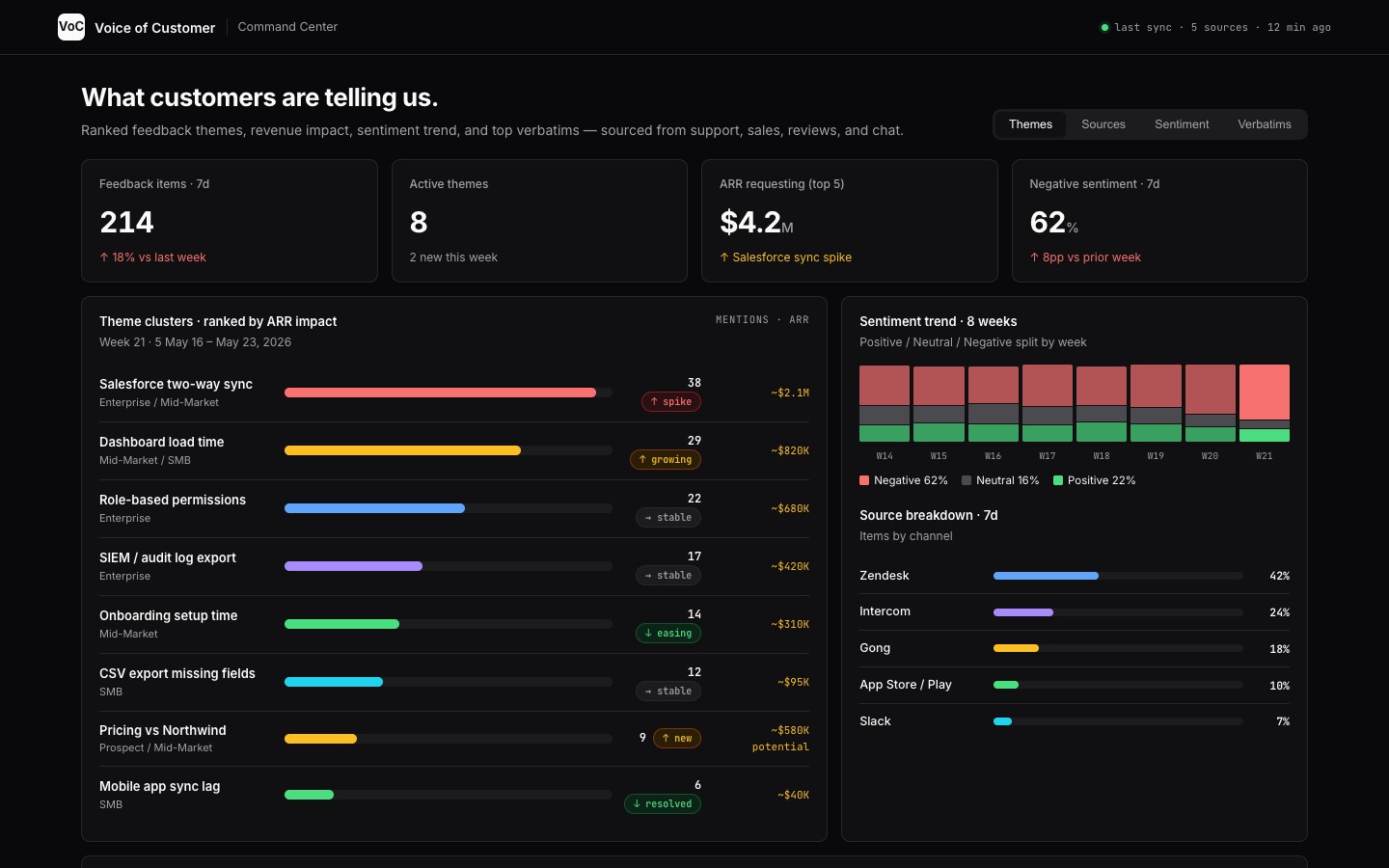
- Open [[dashboard]] — the VoC command center: theme clusters with mention counts, source breakdown, revenue impact bars, sentiment trend, and top verbatims.
- Browse
/feedback/log.md— the raw tagged feedback the daily intake job builds. - Open
/digests/— the weekly digest the VoC Lead publishes each Monday.
Connectors
Required: Zendesk (support tickets), Intercom (chat), Gong (call transcripts), App Store / Google Play reviews.
Recommended: HubSpot or Salesforce (account/MRR enrichment for revenue-impact scoring), Slack (#customer-feedback channel), Productboard (sync themes as insights).
Cross-reference [[competitive-intelligence]] for competitor mentions surfaced in customer feedback.
Every artifact is a file
Agents write every theme cluster, verbatim, and digest to /feedback/, /themes/, and /digests/ as plain markdown files. Nothing lives only in a UI — open, diff, forward, or reference any artifact directly.
$ git clone --filter=blob:none --sparse https://github.com/hilash/cabinets.git && cd cabinets && git sparse-checkout set voice-of-customer